
単相同期化力インバータの開発と、マイクログリッドの構築(シミュレーション、実機実験)Development of a single-phase synchronous inverter and construction of a single-phase microgrid (simulation and field testing)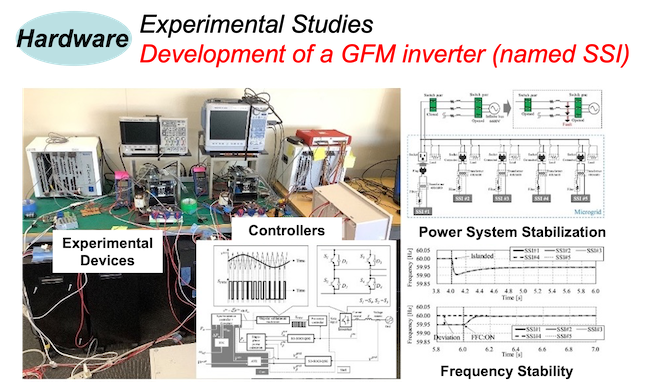
研究の概要
電力システムの末端は単相交流配電線で構成されていますが,単相交流では同期安定性を実現できません。従来の技術では災害時に太陽光発電など単相電源を活用する方策には限界があります。本研究室ではこの問題を解決する、新しいインバータ「単相交流同期化力インバータ(Single-phase Syhnchronous Inverter: SSI)」を開発し, 電力システムの強靱化(レジリエントシステム)を目指しています。このSSIを用いて,単相交流マイクログリッド(Single-phase Microgrid: SMG)を構築するためのインバータ内部の制御系設計などの技術開発を行いながら、広島大学工学部研究教育棟をモデルとした実証試験を行っています。
Research Overview
The end points of power systems consist of single-phase AC distribution lines; however, single-phase AC cannot achieve synchronous stability. Conventional technologies have limitations when it comes to utilizing single-phase power sources, such as solar power generation, during disasters. Our laboratory has developed a new inverter, the “Single-phase Synchronous Inverter (SSI),” to solve this problem, with the goal of creating a more resilient power system. Using this SSI, we are conducting technical development—including the design of internal control systems for inverters—to build a single-phase microgrid (SMG), while simultaneously conducting demonstration tests using the Research and Education Building of the Faculty of Engineering at Hiroshima University as a model.
次世代マイクログリッド向けエネルギー需給制御マネージャの開発(シミュレーション)Development of an Power Supply and Demand Control Manager for Next-Generation Microgrids (Simulation)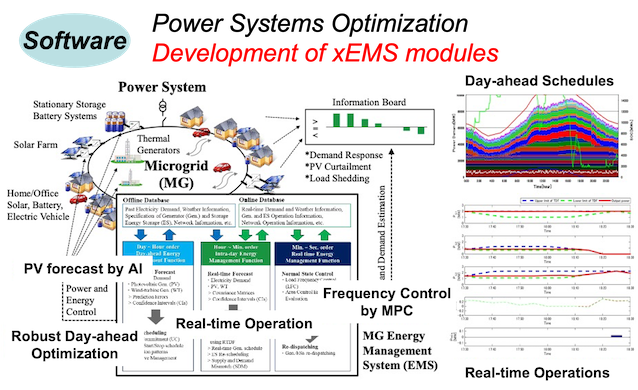
研究の概要
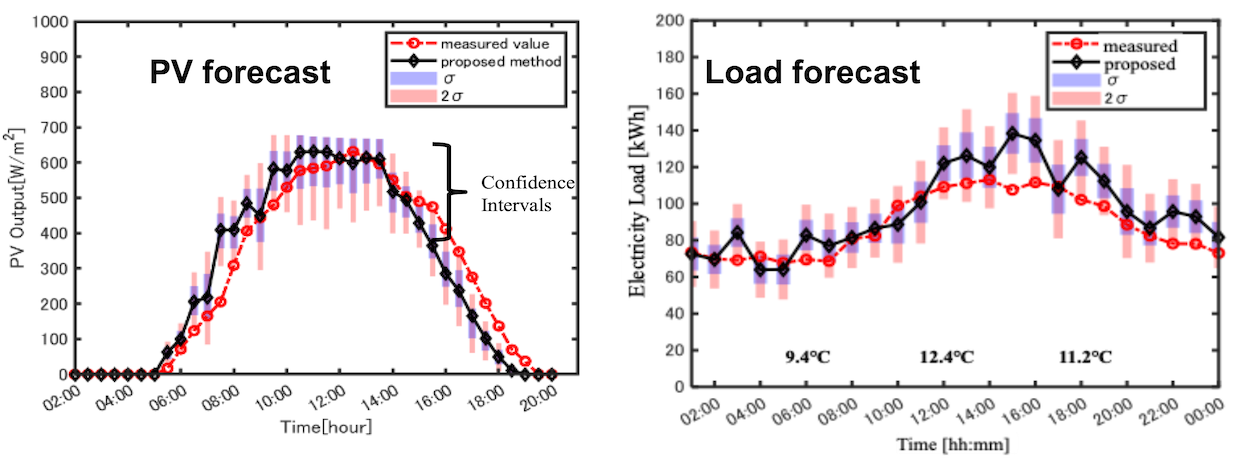
カーボンニュートラルの観点から再生可能エネルギー電源(Variable Renewable Energy: VRE)に注目が集まっています。一方, VREは気象条件により出力が不確定となり, 計画的な出力制御を行いながら電力供給の安定化を図っていく必要があります。正確な予測ができれば,既存火力発電機機や水力発電機機,および定置用蓄電池(Battery Energy Storage System: BESS)や電動車両(Electric Vehicle: EV)のより効率的な運用計画が可能となります。本研究室では、AI/機械学習を用いたPVおよび電力負荷の予測手法を開発し, 予測に基づくロバストな需給計画法と, 実行可能領域の概念に基づくリアルタイム運用手法を提案し, モデル予測制御を用いた高度な需給制御によるエネルギー管理に必要となる総合的な需給制御シミュレータ(電力需給マネージャ)を開発しています。
Research Overview
From the perspective of carbon neutrality, attention is focusing on variable renewable energy (VRE) sources. However, VRE output is subject to uncertainty due to weather conditions, necessitating the stabilization of power supply through planned output control. Accurate forecasting enables more efficient operational planning for existing thermal and hydroelectric power plants, as well as stationary battery energy storage systems (BESS) and electric vehicles (EV). In this laboratory, we are developing PV and electricity load forecasting methods using AI and machine learning. We are proposing robust supply-demand planning methods based on these forecasts, as well as real-time operation methods based on the concept of the feasible region. Furthermore, we are developing a comprehensive supply-demand control simulator (Power Supply-Demand Manager) necessary for energy management through advanced supply-demand control using model predictive control.
AI・機械学習を応用した太陽光発電量・電力需要予測に関する研究
AI/Machine Learning based Solar PV and Load Forecasting 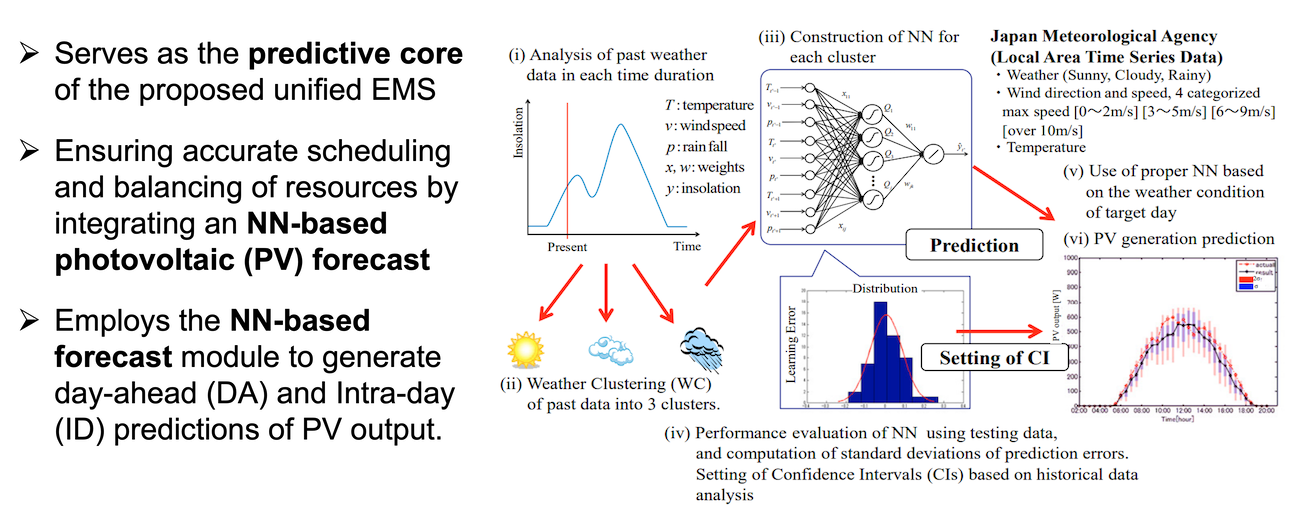
不確定環境下における電力システムのロバスト信頼度に関する研究
Research on the Robust Power System Security in Uncertain Environments
研究の概要
電力システムに太陽光発電が大量に導入された場合,配電系統の電圧調整,出力変動を吸収する調整力不足や周波数変動等の供給信頼度に関する問題が指摘されています。現在,世界的にN-1信頼度基準が採用されていますが,系統運用において,N-1基準とは過負荷,電圧上下限,電圧安定性,過渡安定度,周波数変動(需給バランス制約)といった制約条件を満たすことです。このN-1信頼度基準を満たす運用領域(発電機の出力領域)を静的信頼領域(SS領域:Static Security Region)と呼び,特定の時間断面で定義しました。次に,太陽光発電の予測誤差を考慮し,この変動パラメータ の不確定性が存在しても信頼度が満たされる運用領域をロバスト静的信頼領域(RSS領域:Robust Static Security Region)と定義しました。当研究室では,過渡安定度解析および太陽光発電の不確定出力範囲を考慮した, 新しい信頼度指標を提案しました。
Research Overview
When large-scale solar power generation is introduced into a power system, issues related to supply reliability—such as insufficient regulating capacity to absorb output fluctuations and voltage regulation in distribution systems, as well as frequency fluctuations—have been identified. Currently, the N-1 reliability standard is adopted worldwide. In grid operation, the N-1 standard requires meeting constraints such as overload, voltage upper and lower limits, voltage stability, transient stability, and frequency variation (supply-demand balance constraints). The operating region (generator output range) that satisfies this N-1 reliability standard is called the Static Security Region (SS Region) and is defined at a specific time instant. Next, taking into account prediction errors in solar power generation, we defined the operational region where reliability is maintained even in the presence of uncertainty in these variable parameters as the Robust Static Security Region (RSS region). Our laboratory has proposed a new reliability metric that incorporates transient stability analysis and the range of uncertain output from solar power generation.